
Work 2026
Drawstring
One line turns your REST API into an MCP server, running inside the app you already have.
- Platform
- A library inside your API: Node 20 or later, Python 3.10 or later
- Status
- In development; version 0.1.
- Available in
- Licensed to API vendors; not yet released
- Made by
- Nfemz LLC

The idea
Customers of an API now want to use it from Claude, ChatGPT and Cursor, which reach a product through an MCP server. The usual answer is a second service: its own deployment, its own sign in, and a copy of the API’s permission rules kept in sync by hand.
Drawstring skips that service. A vendor adds one call to the Express, FastAPI or Django app they already run, approves which routes agents may use, and their API answers at its own /mcp address. Every agent call is replayed inside that app, through the vendor’s own auth, tenancy and rate limits, so it can only ever do less than a normal request could.
Screens
-
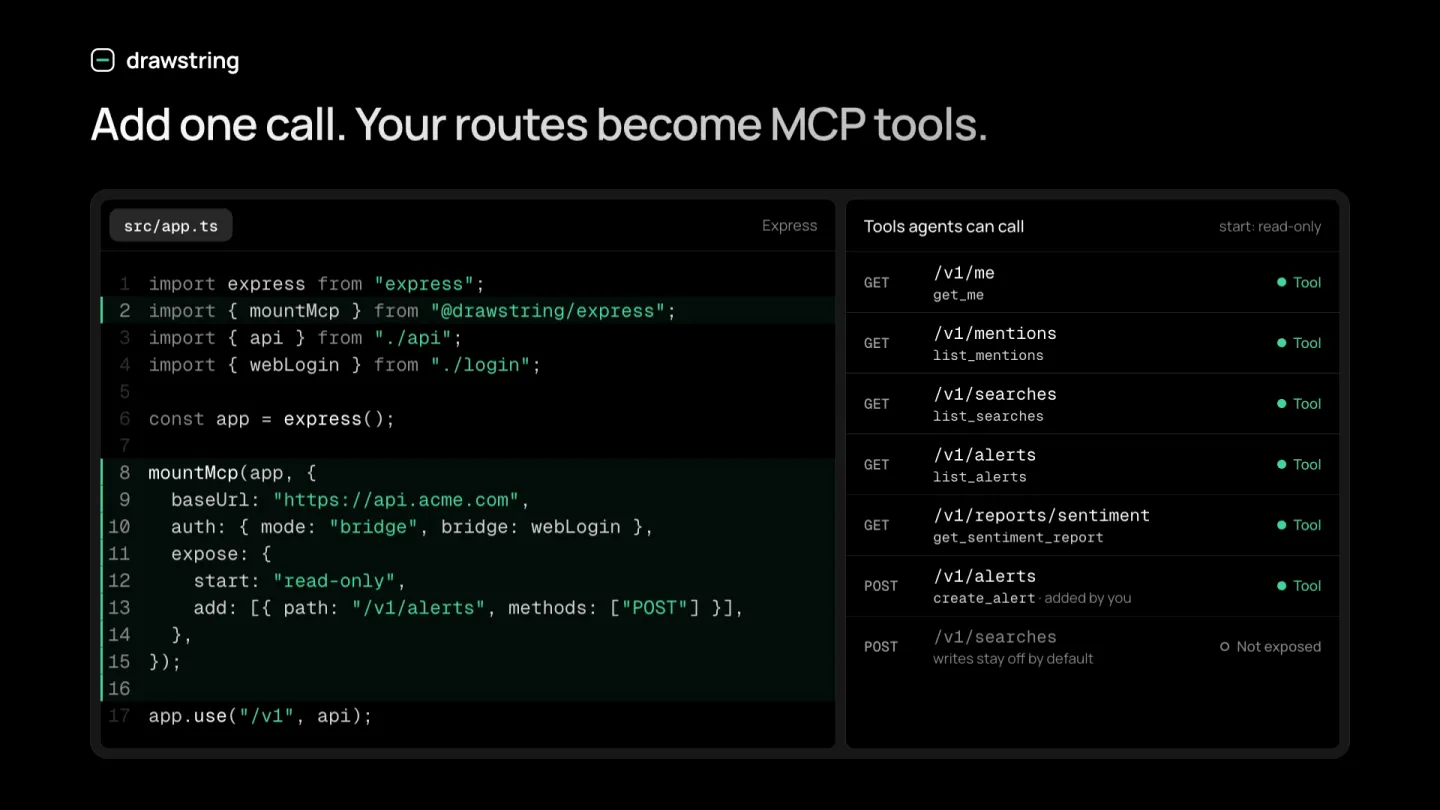
Add one call -
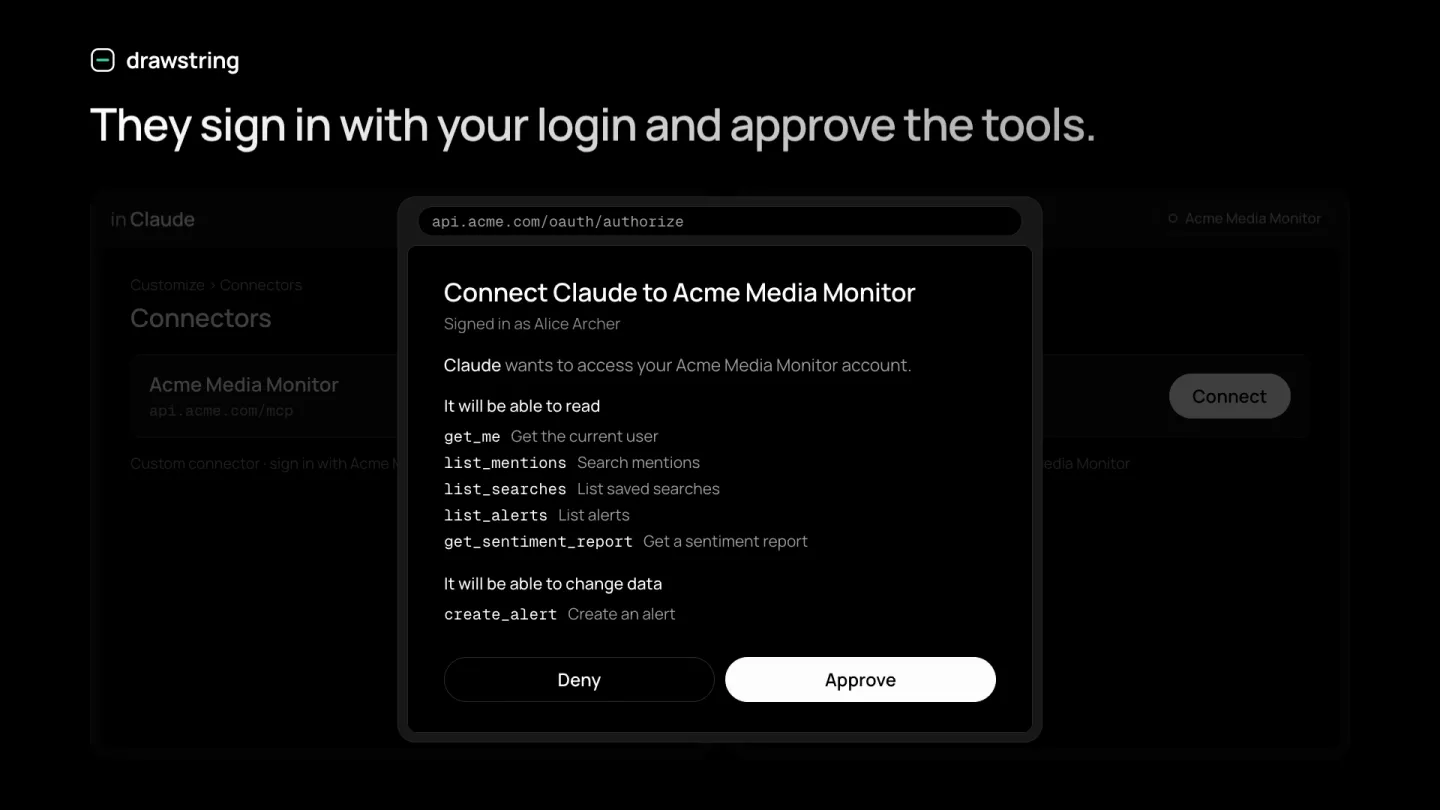
Sign in and approve -
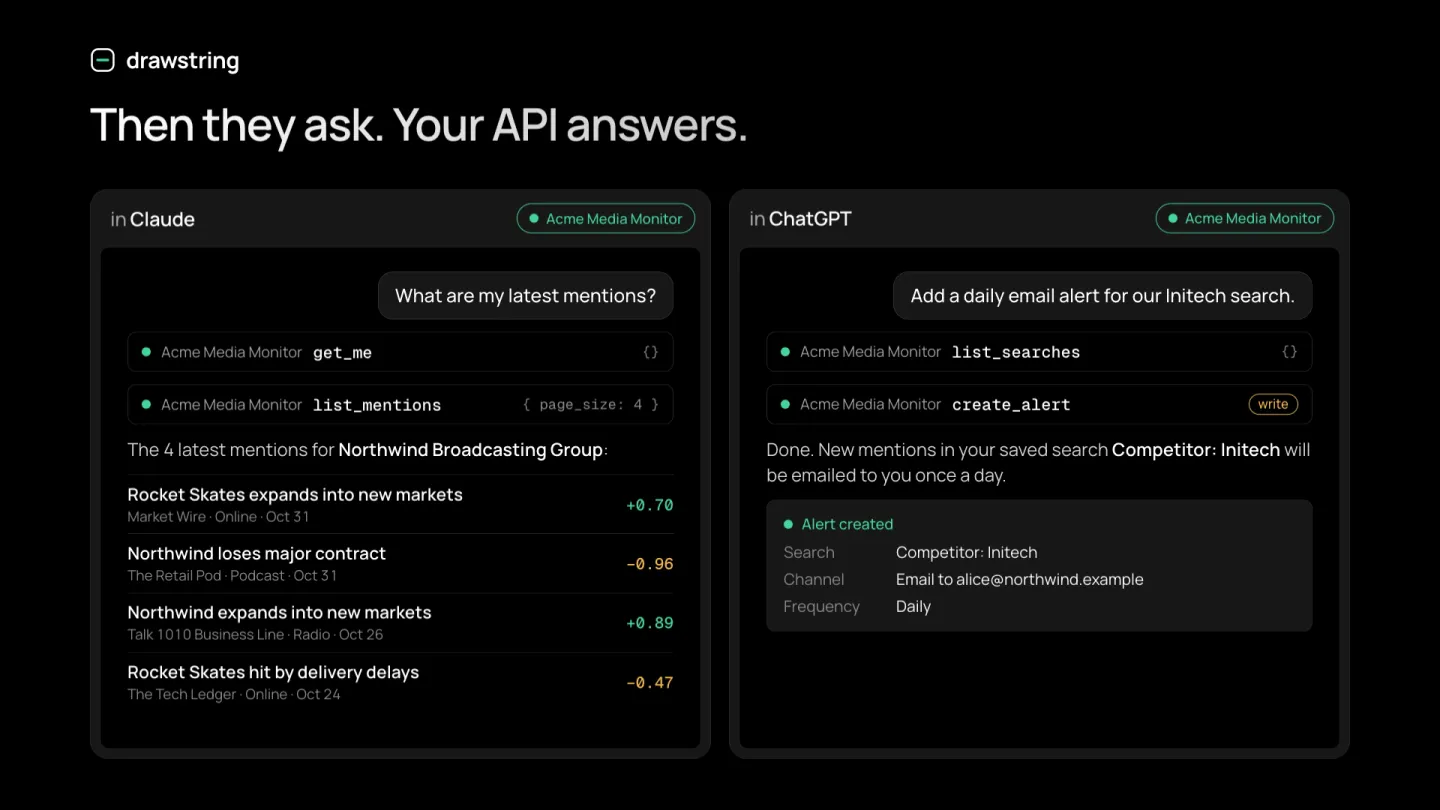
Your API answers
Frames from Drawstring’s 30 second demo, with a made-up API and made-up people.
What it does
Mount it
Call mountMcp before your other middleware. It reads your routes from the framework, plus your OpenAPI spec if you have one. Nothing new to host.
Choose the routes
Start from nothing, read only, or everything, then add and remove by path, method or tag; remove always wins. A route left off the list isn’t a tool: agents can’t call it or see it.
Customers connect
A customer adds your URL to their agent and signs in the way they already do: with their API key, your web login, or your own OAuth server. They see exactly which tools the agent will get.
Revoked means revoked
Customers see every connected agent on a connections page. Revoke one, or revoke a key, and its next call fails.
How it’s built
A library, not a proxy: nothing is hosted, and no traffic leaves the vendor’s servers. Some of the choices behind it:
Replayed through your own middleware
Each tool call is checked against its schema, then run in process as an ordinary HTTP request through the app’s own middleware and handlers. Auth, validation, tenancy, rate limits and logging all apply unchanged, and one customer’s agent gets the same 404 the API would give them.
Two cores, one behavior
A TypeScript core and a Python core, held to identical behavior by one shared conformance suite, with an adapter for each framework: Express, Fastify and Hono on Node; FastAPI, Django and Flask on Python.
Exposure is a file in your repo
The approved routes are written to a lockfile committed with the code and reviewed in pull requests. Production serves exactly that list, and nothing at all without it. A small CLI writes the starter config and the lockfile, and checks that the lockfile is current.
Sign in the way customers already do
Three modes: the customer’s existing API key; an OAuth 2.1 flow placed in front of the vendor’s existing web login, with a consent page and a connections page; or tokens from the vendor’s own OAuth server, such as Auth0, Okta or Microsoft Entra ID.
The current MCP
Stateless Streamable HTTP on the current MCP spec and earlier versions, so Claude, ChatGPT, Cursor and other remote MCP clients connect to it as they would to any remote server.
Off without breaking anything
A configuration error turns off the MCP endpoint, which answers 503 and logs why, and never the rest of the app. Turning it off for good is deleting one line.