
Work 2026
Scrutiny
A read-only IDE for reviewing the code AI agents write, and handing the review back to them.
- Platform
- Mac with Apple silicon, macOS 13 or later
- Status
- In development; version 0.1 in daily use.
- Available in
- Not distributed: a tool its author uses every day
- Made by
- Nfemz LLC

The idea
When an AI agent writes most of the code, the work that’s left is reading it. Pull requests are a poor place to do that: they show a diff, not the codebase it lands in, and they weren’t built for a reviewer whose author is another program. Scrutiny is a Mac IDE made only for reading and reviewing, with full navigation and pull-request-style threads, and it never edits a file.
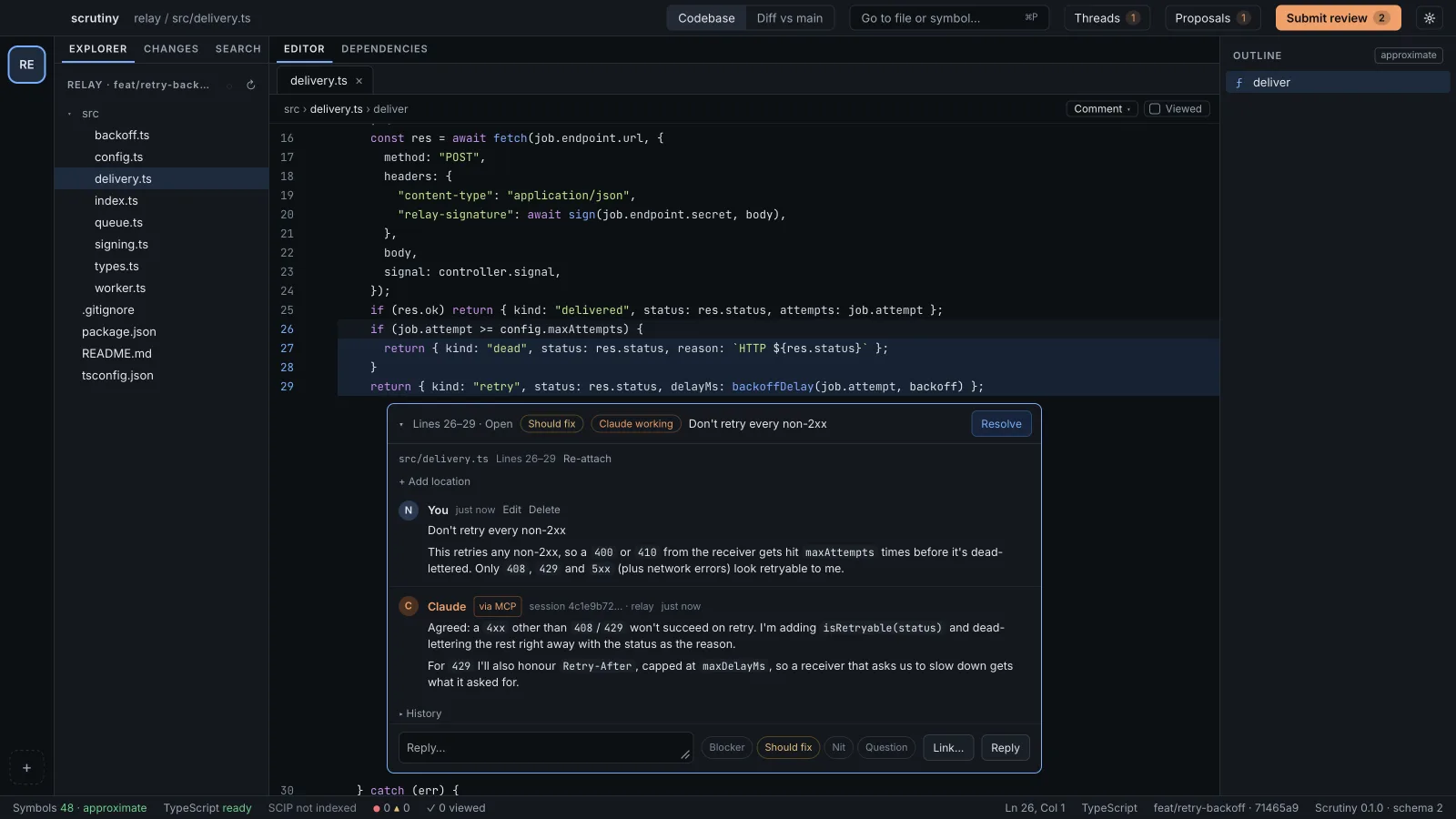
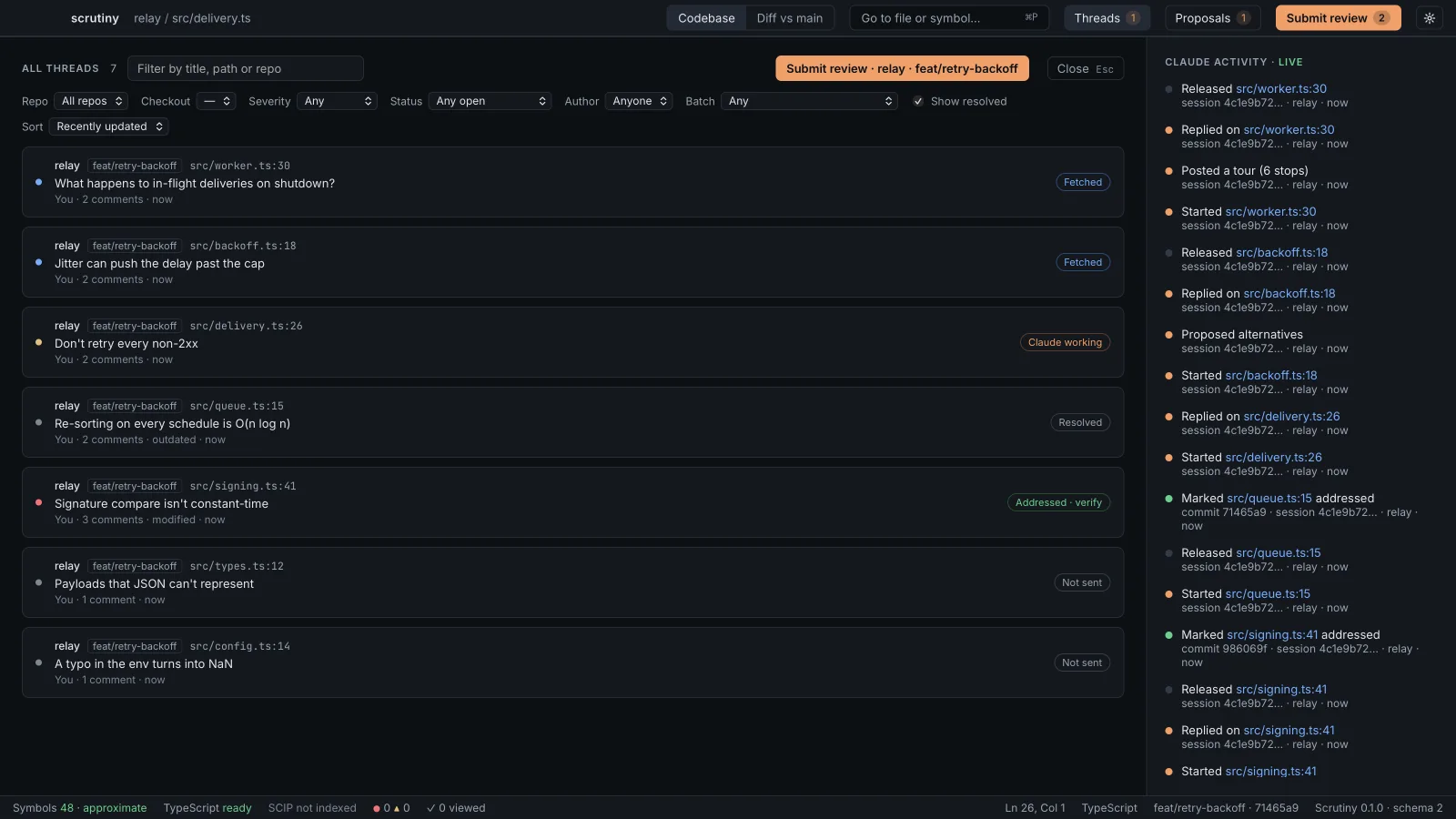
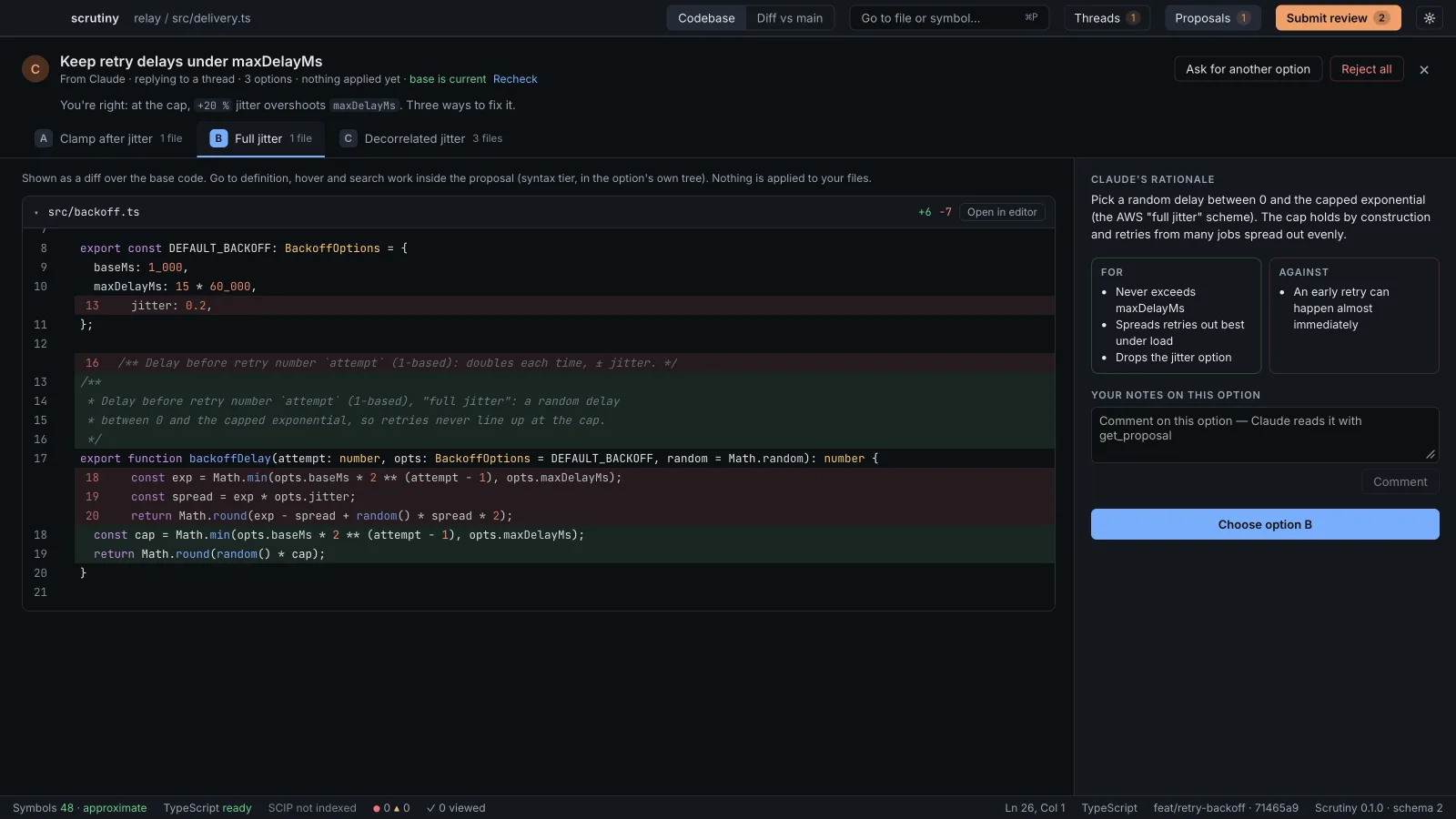
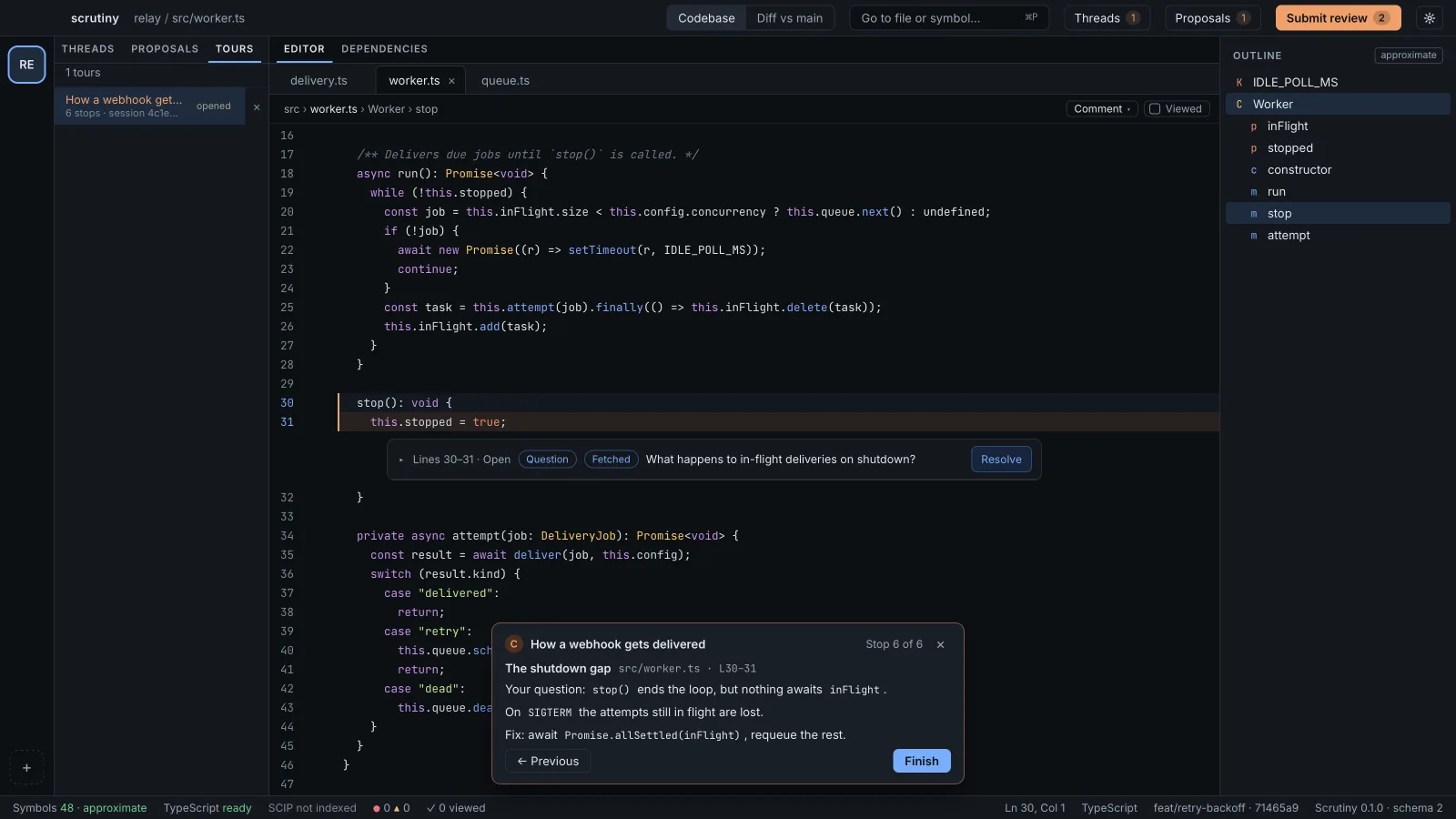
The agent is a first-class participant. It connects to Scrutiny over the Model Context Protocol (MCP): when a review is submitted, it pulls the batch, claims each thread, replies, and marks it addressed with the commit that fixed it. It can propose alternatives for you to choose between, and leave guided tours through the code it wrote. Only you resolve a thread.
Screens
-
A review thread -
Threads and the agent’s activity -
Choosing between proposals -
A guided tour
Screens from Scrutiny 0.1, on a made-up demo repository.
What it does
Navigate like an IDE
Repositories, worktrees and branches are found on their own. A file tree, a fuzzy finder, symbol search, go to definition, references, call hierarchy, search across files, and the code as it is or as a diff against its base, side by side or unified.
Threads that follow the code
Comment on a line, a range, a file or a symbol, with a severity from blocker to nit. When the code changes under a comment, the thread moves with it, and says so when it can’t be sure where it went.
The agent works the review
Submitting a review freezes it into a batch. The agent pulls it, claims threads so two agents never collide, replies, and marks each one addressed with a commit or working-tree snapshot, which you see next to the original before you resolve it.
Proposals and tours
An agent can offer whole alternative versions of a change; you see each as a diff and choose one, reject them all or ask for another. A tour walks you through its work stop by stop, and never moves your view on its own.
Know what you’ve read
Files you’ve marked viewed stay checked until their contents change. A coverage map shows which lines have actually been on screen, and for how long.
More than code
A dependency graph from packages down to modules, Markdown docs rendered with their diagrams, and language-server diagnostics and lint results over the code.
Measured
- median to hand a 20 MB file to the interface over its own URL scheme, against 422–491 ms as JSON
- 15 ms
- scrolling on ProMotion displays, where the system web view defaults to 60
- 120 Hz
- from starting the TypeScript 7 language server to its first definition in a large monorepo
- 0.2–0.5 s
Measured in the design spikes before the build, on an M1 Pro MacBook Pro, November 2026.
How it’s built
A Rust core, a Tauri shell and a React interface, designed and reviewed as a written spec before the first line of code. Some of the choices that mattered:
Rust underneath, a light shell on top
Tauri 2 with a Rust core that owns git, storage, code intelligence and the MCP server, and a React interface with a read-only CodeMirror editor. File contents reach the interface over a custom URL scheme rather than as JSON, which was four to thirty times faster in the spikes.
Read-only, enforced
Scrutiny never writes into the repositories it shows. Every language server, indexer, lint run and git command runs inside a macOS sandbox profile that denies writes and fails closed, and the test gates check that a repository’s git status is untouched afterwards.
Honest code intelligence
Three tiers: tree-sitter parsing for instant outlines and symbols, language servers (TypeScript 7’s native server, basedpyright, rust-analyzer) for exact answers, and SCIP indexes for whole-repository references. Every result is labeled exact, approximate or unavailable, with the reason.
One owner for the data
Reviews live in SQLite in the app’s own folder. The agent talks to a small command-line process over stdio, which forwards to the app through a private local socket; when the app is closed, a headless core answers instead and hands over when the app opens. There is no network listener.
Contracts first
The 23 MCP tools, their JSON Schemas and the interface’s TypeScript types are generated from one Rust protocol crate, and a test fails if any of them drift. Re-anchoring comments is tested against a corpus of edits, renames and moves.
Tested end to end
About 380 Rust tests, about 290 interface unit tests, and 73 end-to-end tests that drive the real app through WebDriver, run as an invisible background app so they never take over the screen.