
Work 2026
Vessel
Nutrition, lifting and body weight in one tracker, with an assistant that can do anything the app can.
- Platform
- iPhone, iOS 17 or later
- Status
- In beta on TestFlight
- Available in
- By invitation, through TestFlight
- Published by
- Nfemz LLC

The idea
Serious tracking usually means several apps: one that counts every nutrient, one that logs every set, and somewhere else for your weight. Vessel is one iPhone app that goes as deep as each of them, nutrition at Cronometer’s depth and lifting the way Strong does it, with body weight and Apple Health alongside.
Every action in the app is also a tool for its built-in assistant. Ask it to log what you ate, build a routine, plan the week’s meals around your calendar or look back at a workout, and it does it through the same operations the buttons use, with an Undo for each change.
Screens
-
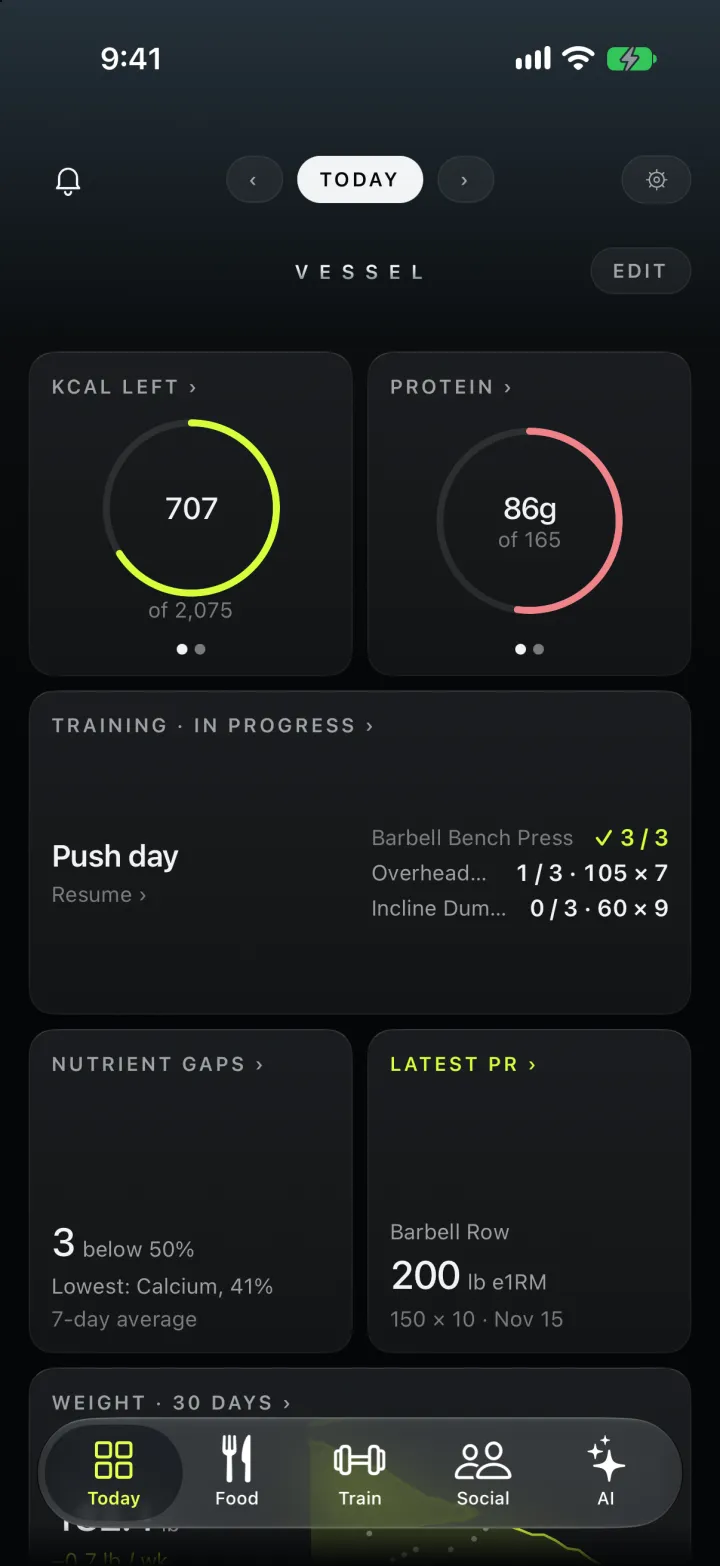
Today -
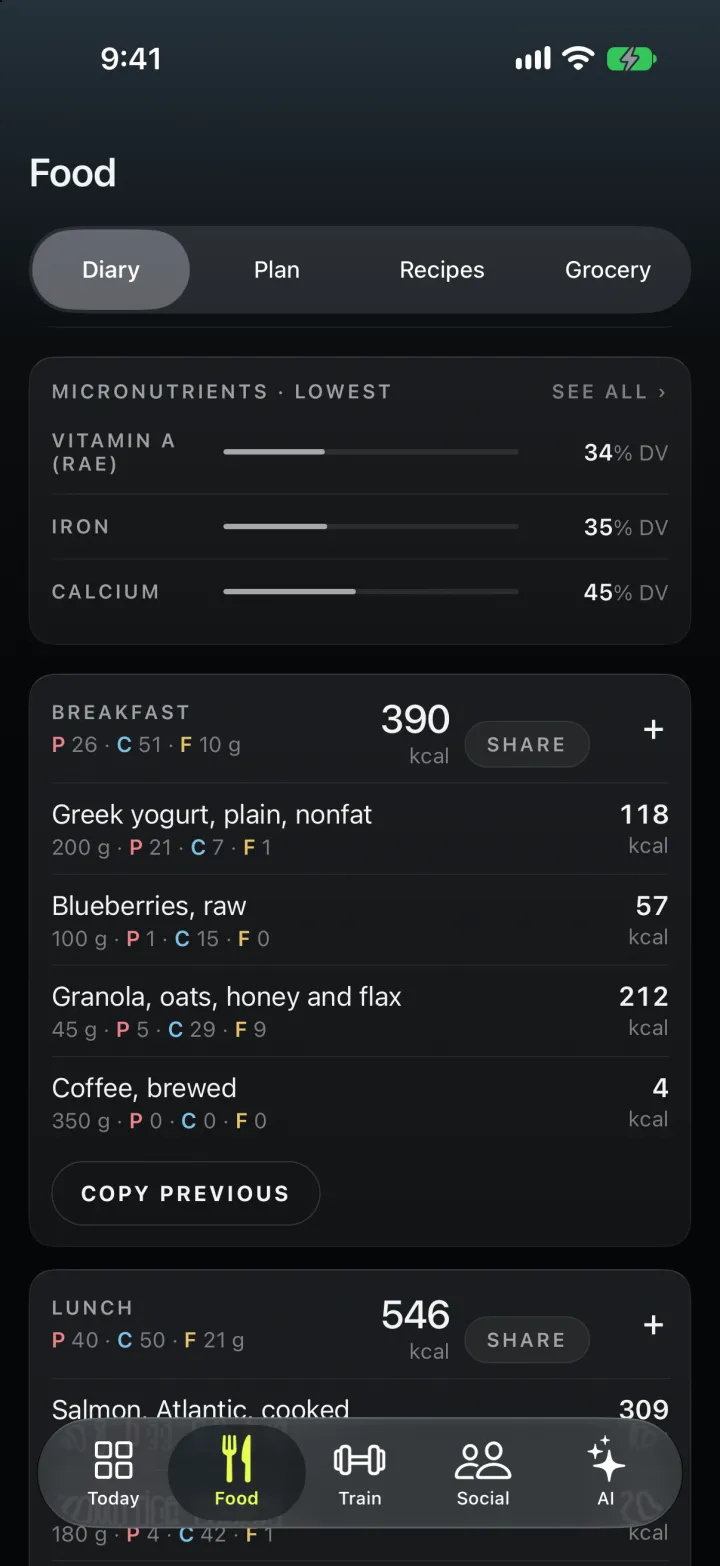
Food diary -
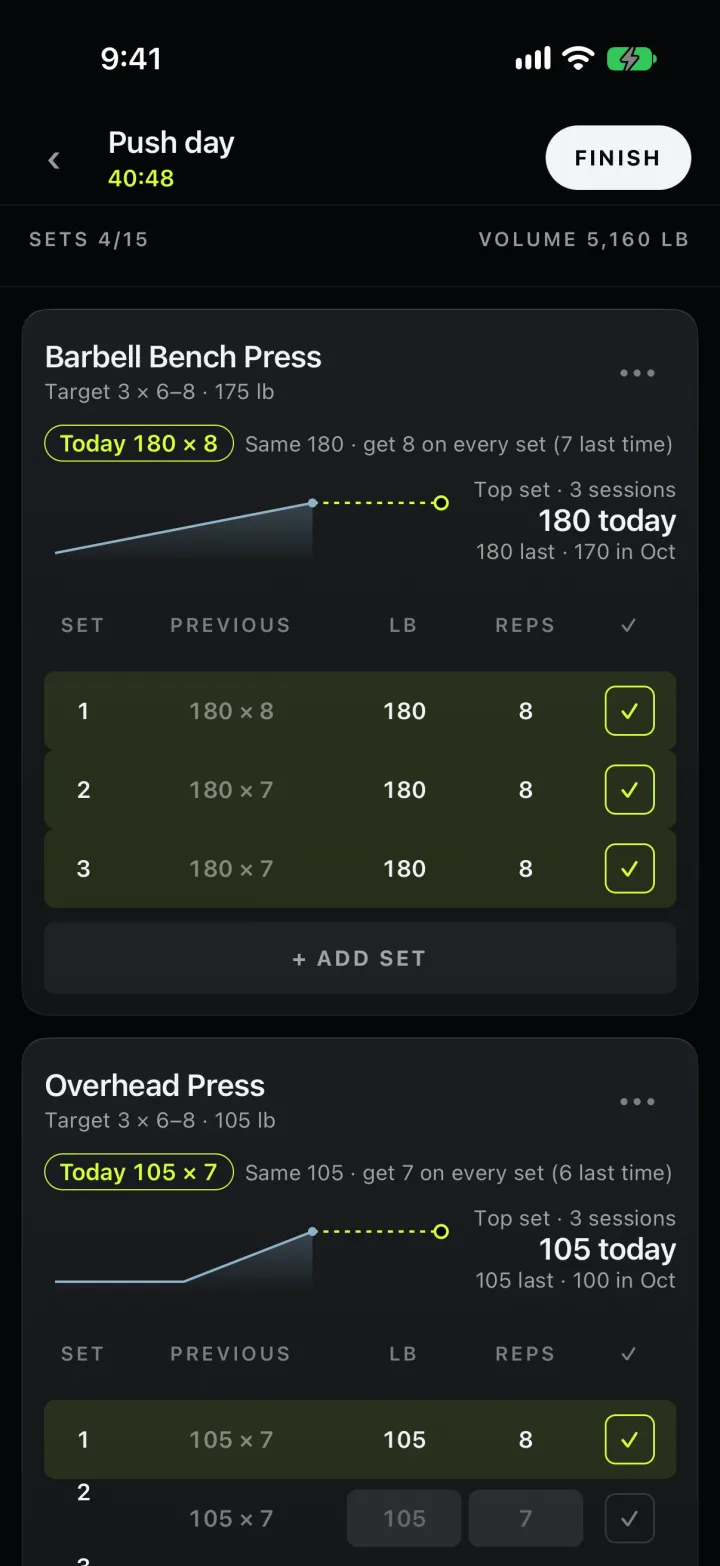
A workout -
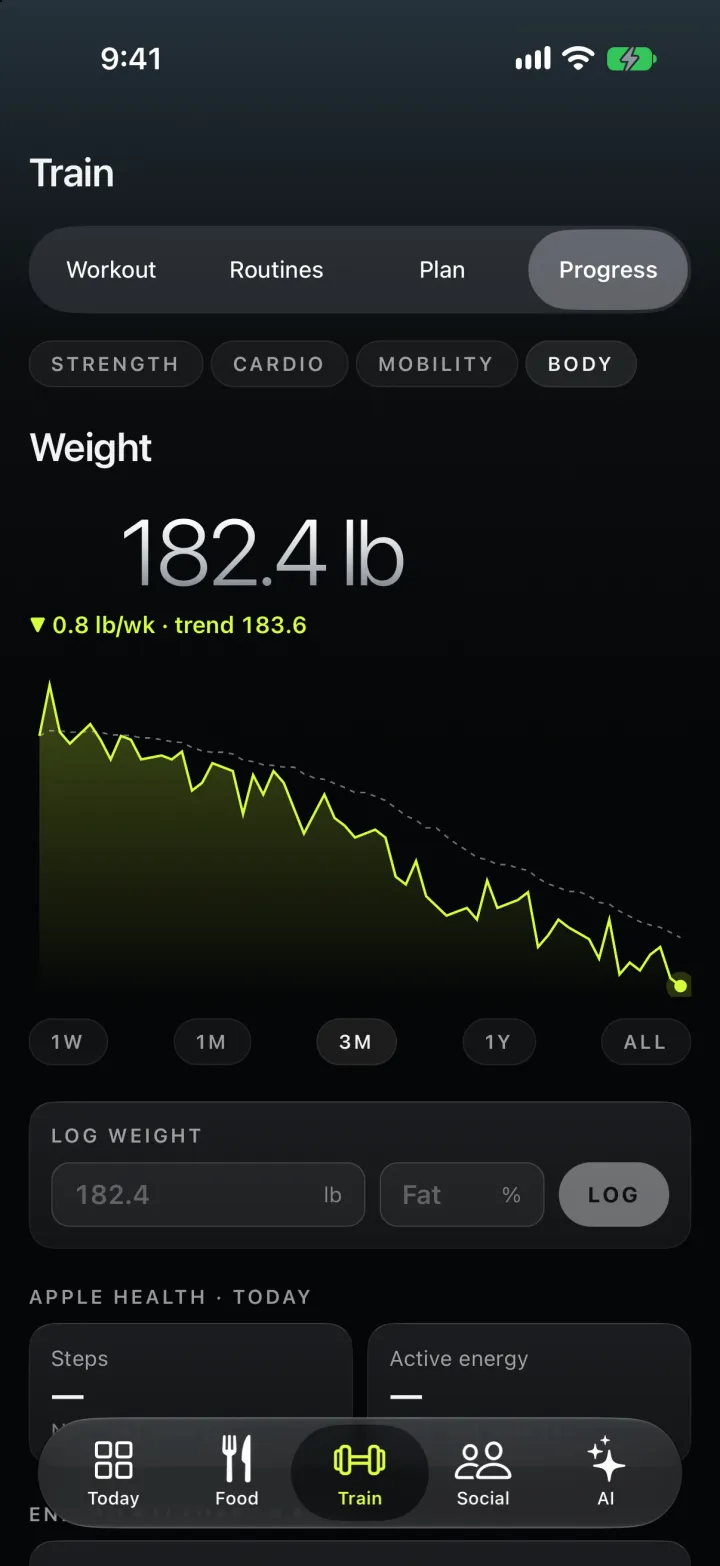
Body trend -
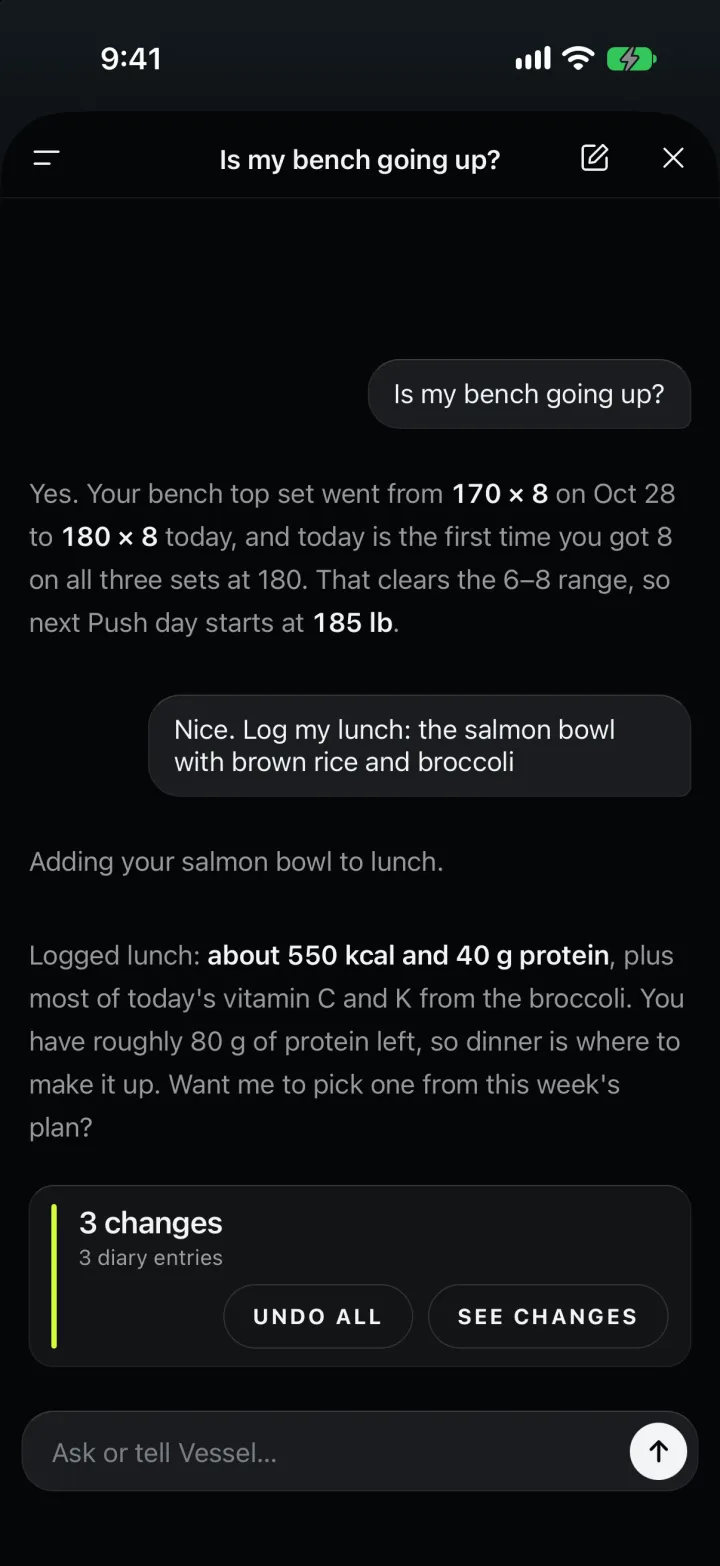
The assistant, with Undo -
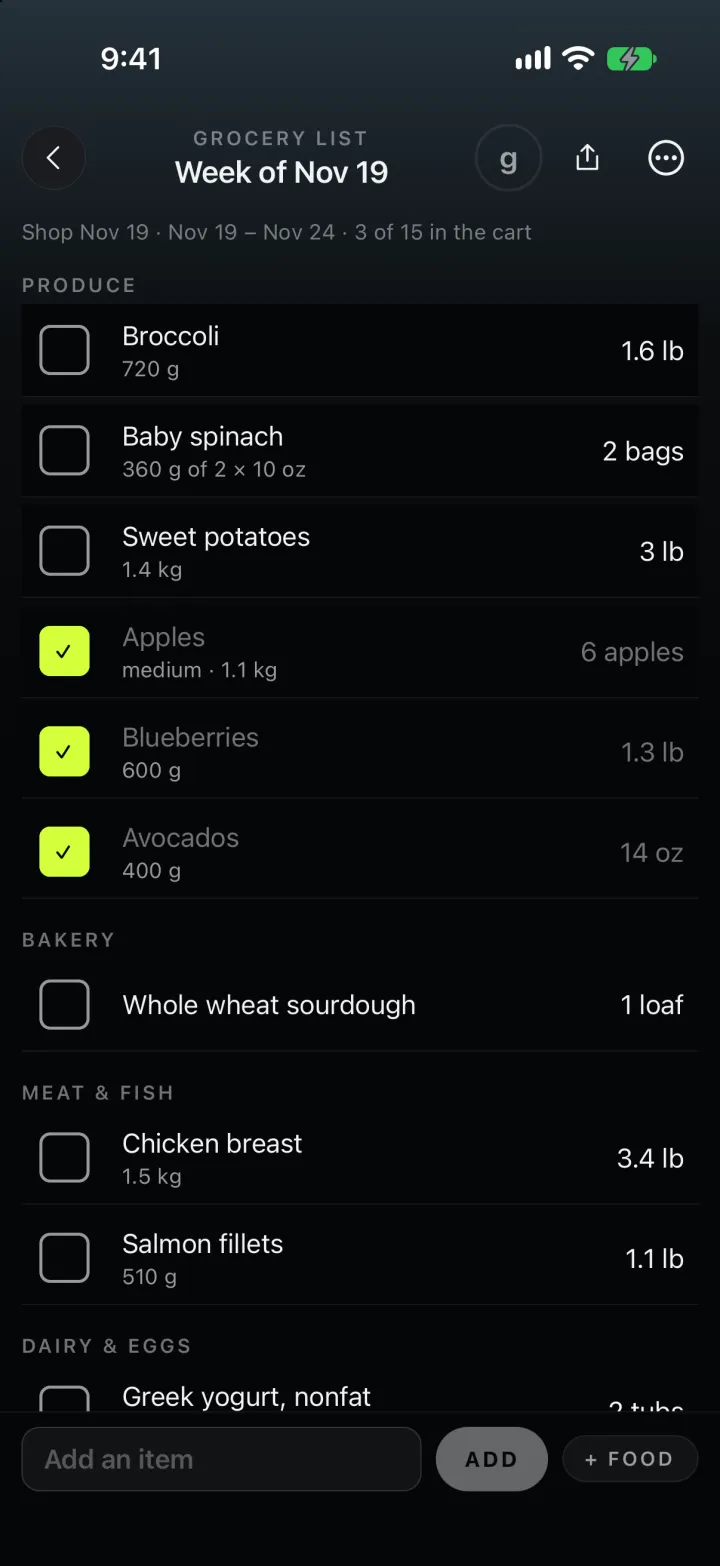
Plan to grocery list
Screens from Vessel, with a made-up person and made-up data.
What it does
Nutrition, nutrient by nutrient
Foods from USDA FoodData Central and Open Food Facts, restaurant menus, barcodes and nutrition-label scans. 79 nutrients tracked against personal targets, with recipes, natural portions and meals you can copy.
Lifting, set by set
Routines with last time’s numbers inline, warm-up, drop and failure sets, supersets and RPE, personal records and estimated one-rep maxes, programs with progression rules, a library of 232 exercises, and a Live Activity while you train.
Body and Apple Health
Weigh-ins with a smoothed trend and weekly rate, and workouts, energy and steps from Apple Health, which feed adaptive energy targets that follow your training.
Plans that react to real life
Meal plans, grocery lists sorted by aisle with a store mode, a kitchen for leftovers, and shared households. Plans adjust around the events on your calendar and the days you’re too tired to cook.
An assistant with the whole app
It acts at once on clear requests and asks first before anything big, like changing targets or deleting. When it needs an answer it shows a native control in the chat, such as a date, a number or a choice.
Friends, if you want them
Handles and friend requests, a feed where you choose who sees each thing, accountability partners and live sessions together.
Measured
- API operations the assistant can call as tools
- 297
- tokens in a chat’s first step, down from 67.9k, once tools were loaded on demand
- 7.3k
- agent evals passed across three runs on Claude Haiku 5.5; the three misses are a baseline that fails by design
- 54 / 57
From the agent evals and measurements recorded in the repo, November 2026.
How it’s built
One person and a team of AI coding agents, held to rules a machine checks on every commit. Some of the choices that mattered:
One operation, three surfaces
Every type starts as a Drizzle table. From it come the schemas, one oRPC contract, and each operation written once: router, service, repository. That one operation is an HTTP endpoint, a TanStack Query hook in the app and a tool for the assistant. A generator scaffolds new trackers and operations the same way.
Tools loaded on demand
With nearly 300 tools, sending them all costs time and money on every step. Each step carries a small core set plus up to 20 the model loads from a generated index, which cut a chat’s first step from 67.9k to 7.3k tokens.
Guardrails for an assistant that writes
Writes run through the same checks as the app, each with an Undo. After a web search, or after reading text other people wrote, the assistant can only propose changes for you to confirm. Deleting your account is never a tool, and widgets in the chat never write on their own.
Rules a machine enforces
48 GritQL rules, each with fixtures that prove it fires on bad code and stays silent on good, plus architecture checks for the router, service and repository layers and the direction features may depend on each other. While a gate is red, git hooks refuse the commit and the coding agents’ own hooks won’t let them finish.
Evals against the real model
Nineteen cases (logging food and weight, building routines and multi-day plans, reviewing a workout, remembering and forgetting) run against a fresh database each time, reporting pass rate, cost per turn and latency, so a model or prompt change is measured before it ships.
Built to release in under 30 minutes
One release command runs the gates, then only the Maestro end-to-end flows a change affects, in parallel on several simulators. Changes to JavaScript ship over the air; a new TestFlight build is made only when the native code changed.
A native app that works offline
Expo and React Native with native iOS tabs (glass on iOS 26), HealthKit, home-screen widgets and Live Activities. Writes made offline wait on the phone and replay when it reconnects, even after a restart.